

In my previous post, I discussed that D365 supports two different prepayment methods for vendors – one with an invoice and one without. In continuation with this series, I’ll be discussing the differences between Vendor Prepayment Invoice vs Vendor Prepayments and walkthrough an example of a Vendor Prepayment without an Invoice.
See related posts:
Customer Prepayment Invoice Feature
Customer Prepayment without an Invoice
Vendor Prepayment Invoice
When to use vendor prepayment invoicing vs. vendor prepayments?
| Prepayment invoicing | Prepayments |
| A prepayment invoice is created | No prepayment invoice needs to be created |
| Payment is applied to the prepayment invoice | Payment is not applied to any invoices |
| Prepayment value is defined on the purchase order | No prepayment value is defined on the purchase order |
| Only 1 prepayment can be defined and paid for 1 purchase order | No limit of number of prepayments to be paid to the vendor |
| Liability for prepayment is held in the AP account. | Liability for prepayment is held in the prepayment account, not the AP account |
| The vendor balance does not reflect the prepayment amount paid to the vendor since it is settled with the prepayment invoice upon payment. | The vendor balance reflects the prepayment amount paid to the vendor until it is applied to the vendor invoice. |
| Depending on the AP Parameter setup, prepayment is applied manually or automatically to invoice during the purchase order invoice posting. | User needs to manually apply the prepayment amount to settle against the posted vendor invoice balance. |
| Depending on the AP Parameter setup, the prepayment amount will automatically be applied to the purchase order invoice or a warning message will appear if the prepayment amount is not applied to the vendor invoice upon creating the purchase order invoice | No warning or indication if the prepayment amount is not applied to the vendor invoice. |
The vendor prepayment function has 3 major steps with the following accounting implications:
- Pay prepayment with payment journal
Debit AP – Prepayment (As setup on prepayment posting profile) $250
Credit Bank $250
- Post purchase order invoice for vendor
Debit Expense $900
Credit AP (As setup on regular AP posting profile) $900
- Settle and apply prepayment with purchase order invoice
Debit AP (As setup on regular AP posting profile) $250
Credit AP – Prepayment (As setup on prepayment posting profile) $250
Complete the necessary setups
Navigate to Accounts payable > Setup > Vendor posting profiles and create the Vendor posting profile for prepayments
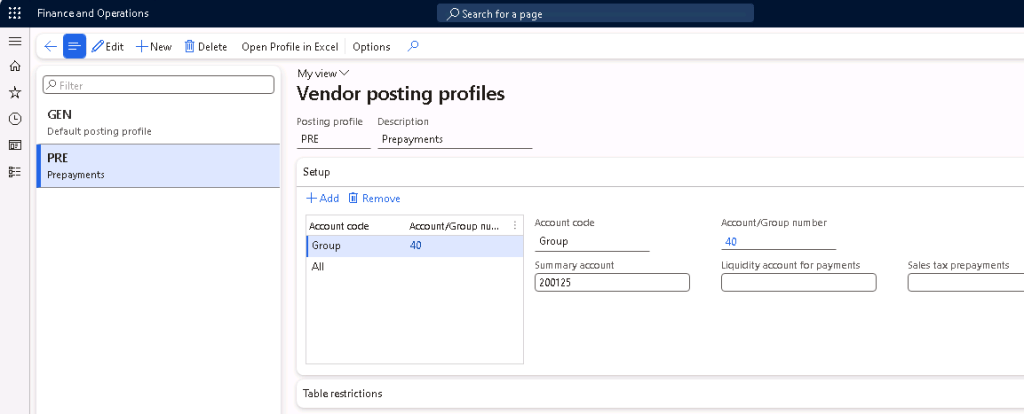
Navigate to Accounts Payable > Setup > Accounts Payable Parameters, under the Ledger and sales tax tab > Payment section, set the “Posting profile for payment journal with prepayment” with the posting profile created in the previous step for prepayment.
You can also choose to define if Sales tax needs to be calculated on prepayment journal voucher by toggling the field “Sales tax on prepayment in payment journal” = “Yes”, then it will calculate sales tax on the payment and the payment journal name setup needs to have “Amounts include sales tax” = “Yes”

Step 1: Create the payment journal
Create vendor payment journal for prepayment (Accounts payable > Payments > Vendor payment journal).
Enter the prepayment amount in the debit field.

Under the Payment tab, select “Yes” for “Prepayment journal voucher”. Notice that the Posting profile will be updated to the posting profile created for prepayment in the AP Parameters setup.
If in AP Parameters’ “Sales tax on prepayment in payment journal” = “No”, then sales tax will not be calculated regardless if Prepayment journal voucher is Yes/No.
If in AP Parameters’ “Sales tax on prepayment in payment journal” = “Yes”, then sales tax will be calculated if Prepayment journal voucher = “Yes” and this payment journal name setup must have “Amounts include sales tax” = “Yes” as well

Post the vendor payment journal.


Step 2: Post purchase order invoice for vendor
Navigate to Accounts payable > Purchase orders > All purchase orders and create and confirm the Purchase Order for the vendor. Then, receive the PO, and post the purchase order invoice.
If there’s a specific purchase order that this prepayment is for, you could apply the prepayment against the purchase order before the invoice is created for the PO. On the PO ribbon, select Invoice > Settle > Open transactions and select the prepayment amount to settle against this PO.



Step 3: Settle and apply prepayment with purchase order invoice
If the prepayment was already applied to the Purchase Order before posting the PO invoice, then the settlement will be automatically posted upon posting the PO invoice and this step can be skipped.
Navigate to Accounts payable > Vendors > All vendors, find the vendor, and click on Vendor > Transactions on the ribbon.
Click on Settlement > Settle transactions.
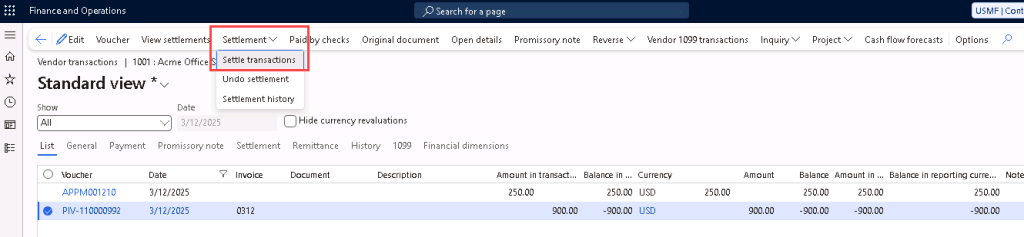
Mark the PO invoice and the prepayment for settlement.
A message should pop-up asking if you want to mark the prepayment transaction for settlement. Click on “Yes”. Then, click on “Post”.

The settlement creates a voucher to reverse the prepayment amount out from the temporarily prepayment AP account as setup on the prepayment posting profile.
If in AP Parameters’ “Sales tax on prepayment in payment journal” = “Yes”, taxes calculated will be reversed as well because the final PO invoice would have actual taxes calculated on it as well.
The purchase order invoice balance will be updated to the correct balance after applying the prepayment invoice.





Leave a Reply